Solar lighting — flood
Solar flood light manufacturer — all-in-one systems with LiFePO4 storage
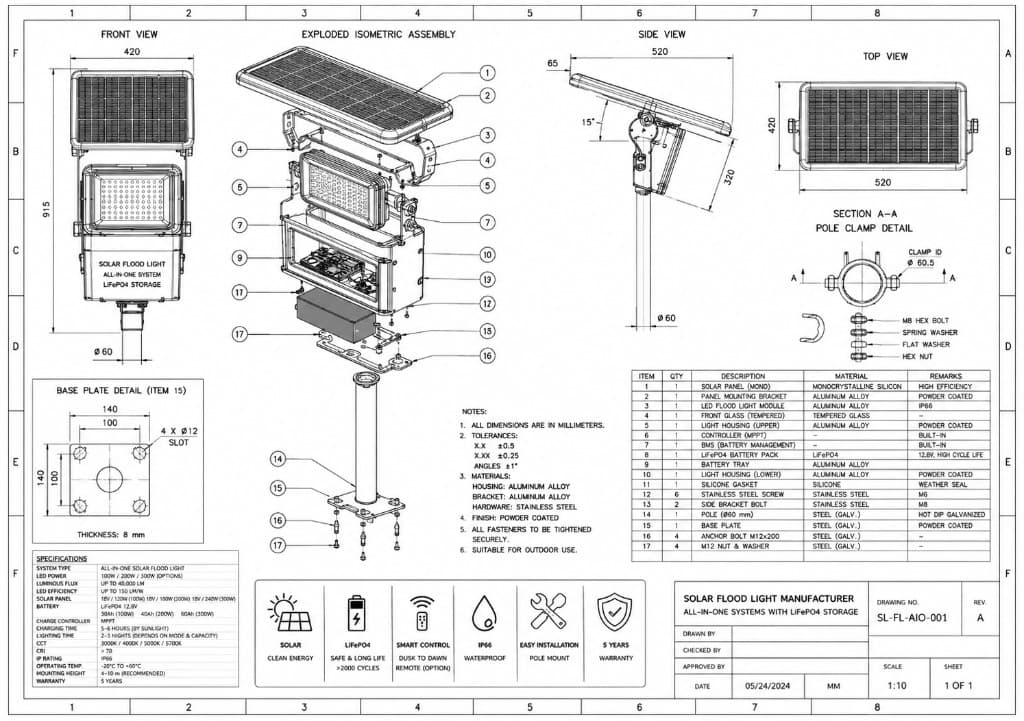
Four all-in-one solar flood series with integrated panel, LiFePO4 battery, and dusk-to-dawn control. For compounds, yards, gardens, signage, and sites with no reliable grid. Manufactured in Guzhen, open to OEM and ODM.
Solar lighting — flood
An all-in-one solar flood light is a small off-grid power system with a luminaire attached, and it fails or succeeds on the power system. Panel area, battery capacity, and controller behaviour decide whether it still lights at 4 a.m. in December; the LED is the easy part. Our range is specified around that, which is why every product page states battery chemistry and capacity rather than only a wattage.
All four series use LiFePO4 chemistry rather than lithium-ion or lead-acid. LiFePO4 tolerates heat far better, survives several thousand cycles instead of several hundred, and does not degrade as fast when it sits partially charged through a cloudy week. In a solar light the battery is the part that dies first, so this is the specification that determines service life.
The solar flood light range
Four series from compact garden and signage units to large aluminium project floods. Battery capacity, panel, and lumen output are published on each product page.
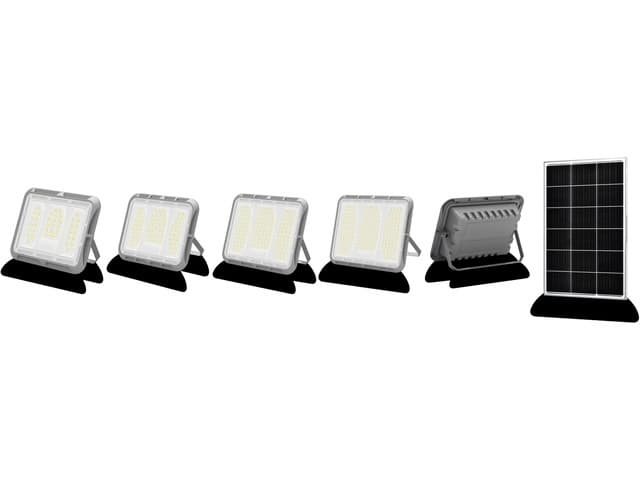
PL Solar Flood Light — 5054 LED Series
The PL Solar Flood 5054 series is an all-in-one solar flood light featuring ABS housing, a built-in LiFePO4 battery (3.2 V, 13–32.5 Ah), and 5054 LED chips rated at 1,200–3,000 lm for 100–400 W nominal power equivalents. An intelligent light sensor provides automatic dusk-to-dawn control. The integrated 6 V solar panel (25–50 W) makes installation simple and grid-independent. IP65 rated, water-proof and designed for green-energy projects in remote areas.
View specifications →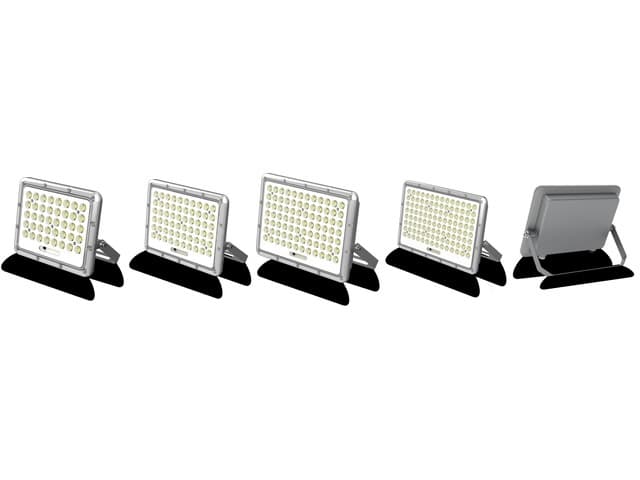
GR2 Aluminium Solar Flood Light
The GR2 is a mid-to-large aluminium solar flood light featuring 5054 LED chips for crisp, uniform illumination at 1,200–3,000 lm. Its durable aluminium die-cast body and IP65 protection make it suitable for industrial yards, car parks and public areas. LiFePO4 battery (3.2 V, 13–32.5 Ah) and a 6 V 25–67 W solar panel provide reliable off-grid performance. CE, RoHS certified.
View specifications →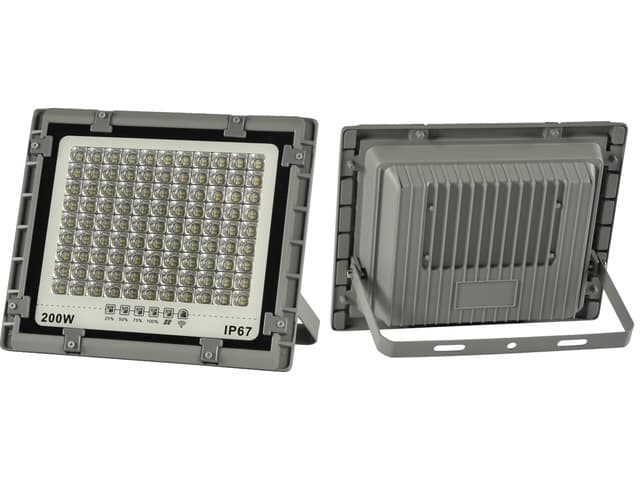
BK/GR Aluminium Solar Flood Light
The BK/GR Solar Flood Light features 2835-0.2W LED arrays of 256–624 chips for excellent light uniformity, available in black (BK) or grey (GR) aluminium housings. Its 100–400 W range delivers 1,200–3,000 lm. Built-in LiFePO4 battery (3.2 V, 13–32.5 Ah) and 6 V 25–67 W solar panel provide multi-night autonomy. IP65 waterproof, automatic dusk-to-dawn control, CE and RoHS certified.
View specifications →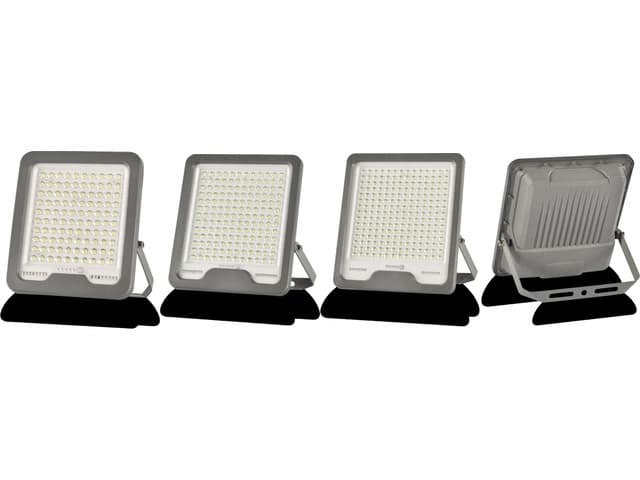
GW Solar Flood Light
The GW Solar Flood Light is a compact aluminium-housed solar luminaire ideal for garden paths, security zones and signage lighting. Its 10–30 W range with 1,200–3,000 lm 5054 LED chips and LiFePO4 battery (3.2 V, 13–34 Ah) gives multiple nights of autonomy. The 6 V 25–50 W solar panel and automatic dusk-to-dawn control make it fully off-grid. IP65 waterproof, CE, RoHS.
View specifications →Solar flood light specification comparison
Side-by-side specifications including battery, panel, housing, and control — the values that determine whether a solar light performs through winter.
| Specification | PL-5054PL Solar Flood Light — 5054 LED Series | GR2-SFLGR2 Aluminium Solar Flood Light | BK-GRBK/GR Aluminium Solar Flood Light | GW-SFLGW Solar Flood Light |
|---|---|---|---|---|
| Series | PL Solar Flood — 5054 LED | GR2 Aluminium Solar | BK/GR Aluminium Solar | GW Solar Flood |
| Power Range | 100–400 W | 100–400 W | 100–400 W | 10–30 W |
| Luminous Flux | 1,200–3,000 lm | 1,200–3,000 lm | 1,200–3,000 lm | 1,200–3,000 lm |
| LED Chips | 5054 — 40/80/142/223 LEDs | 5054 — 50/84/112/160 LEDs | 2835-0.2W — 256/288/396/624 PCS | 5054 — 100/156/210 LEDs |
| Battery | LiFePO4 3.2 V, 13–32.5 Ah | LiFePO4 3.2 V, 13–32.5 Ah | LiFePO4 3.2 V, 13–32.5 Ah | LiFePO4 3.2 V, 13–34 Ah |
| Solar Panel | 6 V, 25–50 W | 6 V, 25–67 W | 6 V, 25–67 W | 6 V, 25–50 W |
| Housing | ABS | Aluminium Die-Cast | Aluminium BK (Black) / GR (Grey) | Aluminium |
| Control | Auto Dusk-to-Dawn | Auto Dusk-to-Dawn | Auto Dusk-to-Dawn | Auto Dusk-to-Dawn |
| IP Rating | IP65 | IP65 | IP65 | IP65 |
| Green Energy | ✓ Solar Self-Sufficient | ✓ Solar Self-Sufficient | ✓ Solar Self-Sufficient | ✓ Solar Self-Sufficient |
| Certifications | CE, RoHS | CE, RoHS | CE, RoHS | CE, RoHS |
A dash means the specification is not published for that series. Power classes follow industry labelling convention; read the lumen and battery rows for real performance.
Which solar flood light for which site
Autonomy requirement and ambient temperature matter more than the marketed power class. A shortlist by application:
| Site or application | Recommended series |
|---|---|
| Compound, yard, or perimeter with no grid connection | PL 5054 all-in-one, LiFePO4 13–32.5 Ah |
| Larger project area, hot climate, long service life required | GR2 aluminium solar flood, 5054 LED chips |
| Visible façade or architectural position, colour-matched | BK/GR aluminium, black or grey housing |
| Garden path, signage, doorway, or small security zone | GW compact solar flood, 10–30 W |
| Site needing several nights of autonomy after cloud | PL 5054 with the largest LiFePO4 option, dimming schedule |
| Own brand, specific battery capacity, or a bespoke panel and housing | OEM or ODM build — see custom manufacturing below |
Solar flood lights
How to read solar flood light wattage — and why not to trust it
Solar flood lights are marketed in power classes like 100 W to 400 W, and those numbers do not mean what they mean on a mains fixture. They describe the class or the equivalent, not the LED load, which is why our published lumen output across the range is 1,200 to 3,000 lm rather than the tens of thousands a 400 W mains flood produces.
This is an industry-wide labelling habit and we would rather explain it than exploit it. Specify by two numbers instead: the lumen output you need on the target area, and the hours of autonomy you need after a cloudy day. Every product page here publishes the lumen figure and the battery capacity so you can do that arithmetic. If a supplier quotes you a 400 W solar flood at 40,000 lm, ask for the battery capacity and check whether the panel could ever recharge it.
Autonomy, panel sizing, and winter performance
Autonomy is the number of nights the light runs on stored charge with no useful solar input. Sizing it means knowing the site latitude, the worst-month solar irradiation, the nightly run hours, and how much output you are prepared to lose in a dimming schedule. A unit sized for Riyadh will underperform in Brussels in January, using identical hardware.
The PL 5054 series carries a 3.2 V LiFePO4 pack from 13 Ah to 32.5 Ah so autonomy can be matched to the site rather than fixed by the housing. Tell us the location, the run hours you need, and whether a reduced-output overnight schedule is acceptable, and we will state the expected autonomy in the worst month rather than a best-case figure.
Aluminium or ABS housing
The GR2, BK/GR, and GW series use aluminium housings; the PL 5054 uses ABS. Aluminium sheds heat better, which matters because battery life falls sharply with temperature — in a hot climate an aluminium body is protecting your battery as much as your LEDs. It also survives impact and UV over a longer service life.
ABS is lighter and cheaper, and on a shaded or temperate site the thermal advantage of aluminium is largely theoretical. The BK/GR series ships in black or grey, which is a practical detail on projects where fixtures sit on a visible façade and the architect has an opinion. For coastal sites, ask us about the coating specification rather than assuming aluminium alone is enough.
Control, dusk-to-dawn, and what to expect from PIR
All series switch automatically dusk to dawn. The practical question is what happens in the middle of the night, because running at full output until sunrise is what flattens an undersized battery. Scheduled step-dimming — full output for the first hours, reduced output through the quiet period — is usually the difference between a light that works all year and one that dies at 2 a.m. every winter.
Motion sensing extends autonomy substantially for security applications, at the cost of an unlit area until something moves into it. That is right for a rear compound and wrong for a footpath. Tell us the application and we will recommend a control profile rather than defaulting to the one with the best-sounding runtime figure.
Custom solar lighting production — OEM and ODM
Solar is where custom manufacturing earns the most, because autonomy requirements are genuinely site-specific and a catalogue battery size is a compromise almost everywhere. We build to a specified battery capacity, panel rating, controller profile, and dimming schedule rather than asking you to pick the nearest standard unit.
We also produce private-label solar ranges for distributors: your brand on housing, carton, and manual, your choice of housing colour and finish, and a controller programmed to your dimming profile. If you are tendering against a written autonomy specification, send it — we will state plainly whether it is achievable at that panel and battery size, including when it is not.
Solar flood light questions buyers ask
How long do your solar flood lights run at night?
It depends on site latitude, worst-month solar irradiation, the nightly run hours, and whether a reduced-output overnight schedule is acceptable — identical hardware performs very differently in Riyadh and in Brussels. The PL 5054 carries a 3.2 V LiFePO4 pack from 13 Ah to 32.5 Ah so autonomy can be sized to the site. Send location and required run hours and we will state expected worst-month autonomy rather than a best-case number.
Why is a 400 W solar flood light only 3,000 lumens?
Because solar flood light power classes describe the class or equivalent, not the LED load — an industry-wide labelling habit. A genuine 400 W of LED draw would need a panel and battery far larger than any all-in-one housing holds. We publish the real lumen output and the battery capacity on every product page so you can specify by output and autonomy instead. If a supplier quotes 40,000 lm from an all-in-one solar flood, ask what battery is fitted and whether the panel could recharge it.
What battery do your solar lights use, and how long does it last?
LiFePO4 across the whole range. It tolerates heat far better than lithium-ion, delivers several thousand charge cycles instead of several hundred, and degrades more slowly when left partially charged through cloudy periods. In an all-in-one solar light the battery is normally the first component to fail, so this is the specification that sets service life — which is also why we favour aluminium housings in hot climates.
Do solar flood lights work in winter or in cloudy climates?
Yes, if they are sized for it, which means panel and battery matched to worst-month irradiation rather than to an annual average — plus a dimming schedule so the fixture is not at full output until sunrise. Most solar lighting disappointment comes from units sized on summer figures. Tell us the location and we will size for the worst month and say what output you should expect.
Can you supply solar flood lights with our brand and our battery specification?
Yes. We manufacture in Guzhen, so private-label branding, a specified battery capacity, a particular panel rating, a housing colour, and a programmed controller profile are all changes we make in production. Send an autonomy specification and we will confirm whether it is achievable at that panel and battery size before you commit.
Are your solar flood lights waterproof?
The range is IP65, which covers driving rain and dust and is the correct rating for essentially all outdoor mounting positions. IP65 does not mean submersible — if fixtures will be pressure-washed or mounted where standing water can reach them, tell us and we will quote a higher ingress rating as a custom build.
Other product families
Request a solar lighting quote
Send the site location, the run hours you need, and quantity. We will size panel, battery, and autonomy before quoting. English, French, and Arabic.