OEM and ODM
Custom outdoor and solar lighting manufacturing — OEM and ODM
We manufacture our own outdoor and solar luminaires in Guzhen, Zhongshan. That means a specification does not have to match a catalogue page: we build to your brand, your housing, your battery capacity, and your photometric target.
- Factory
- Guzhen, Zhongshan
- Scope
- OEM and ODM
- Spec review
- No charge
Your request
Send a specification
Five stages. The first two cost you nothing and are where most of the risk gets removed.
By sending this form you agree to our privacy policy.
What to send us
The more of this you can provide, the faster and more accurate the quote. Partial information is fine — we will tell you what is missing.
- Product type and the application: road, area, façade, warehouse, off-grid compound
- Quantity, and whether this is a one-off project or a repeating range
- Target lumen output or the required lux on the surface, plus mounting height
- Mains voltage at site, or for solar: location, nightly run hours, and required autonomy
- Branding requirements: logo, carton artwork, manual language, labelling format
- Certifications or national marks the destination market requires
- Any tender clauses, competitor datasheets, or drawings you are working against
OEM and ODM
Most lighting suppliers sourcing from Guzhen are trading companies. They can change the label on a carton and very little else, because the factory is somebody else. We manufacture, which changes what is negotiable — the driver, the LED package, the optic, the housing, the battery, the controller firmware, and the certification path are all things we can move.
That distinction matters most in two situations: when you are building a brand and need the product to be yours rather than a rebadged catalogue item, and when you are answering a tender whose clauses no standard luminaire satisfies. Both are routine work for us. What follows is what we actually change, how the process runs, and where the honest limits are.
What we change
Ordered roughly from the fastest and cheapest to the most involved. Most projects need only the first two or three.
- 01
Private-label branding (OEM)
Your logo and part numbers on the housing, carton, and manual, your artwork and language on the packaging, and your labelling format for barcodes and ratings plates. Applied to an existing series in production, this is the fastest route to an own-brand range and carries the lowest MOQ.
- 02
Specification changes to an existing series
Colour temperature, beam angle, LED package brand, driver brand, surge protection level, housing colour to your RAL reference, cable and connector type, and IP rating above the standard IP65. These are changes to a production run rather than a new product, so lead times stay close to standard.
- 03
Solar system sizing
Battery capacity, panel rating, controller dimming profile, and motion-sensor behaviour specified to your site rather than to the nearest catalogue unit. On solar this is where most of the value sits, because autonomy requirements are genuinely site-specific and a standard battery is a compromise almost everywhere.
- 04
Photometric and lighting design
Dialux and Relux layouts, lux-level verification, pole-spacing and mounting-height calculations, and IES or LDT files for your own designer. For road projects we will produce the calculation that demonstrates the target lighting class for your specific geometry, which is what a tender actually asks for.
- 05
Certification and documentation support
CE, CE-EMC, CE-LVD, and RoHS are held across the range, and we supply certificates and test reports in a form you can submit directly. Where a market requires a national mark we will tell you what testing is needed and what it adds to the timeline before you commit.
- 06
New housing and tooling (ODM)
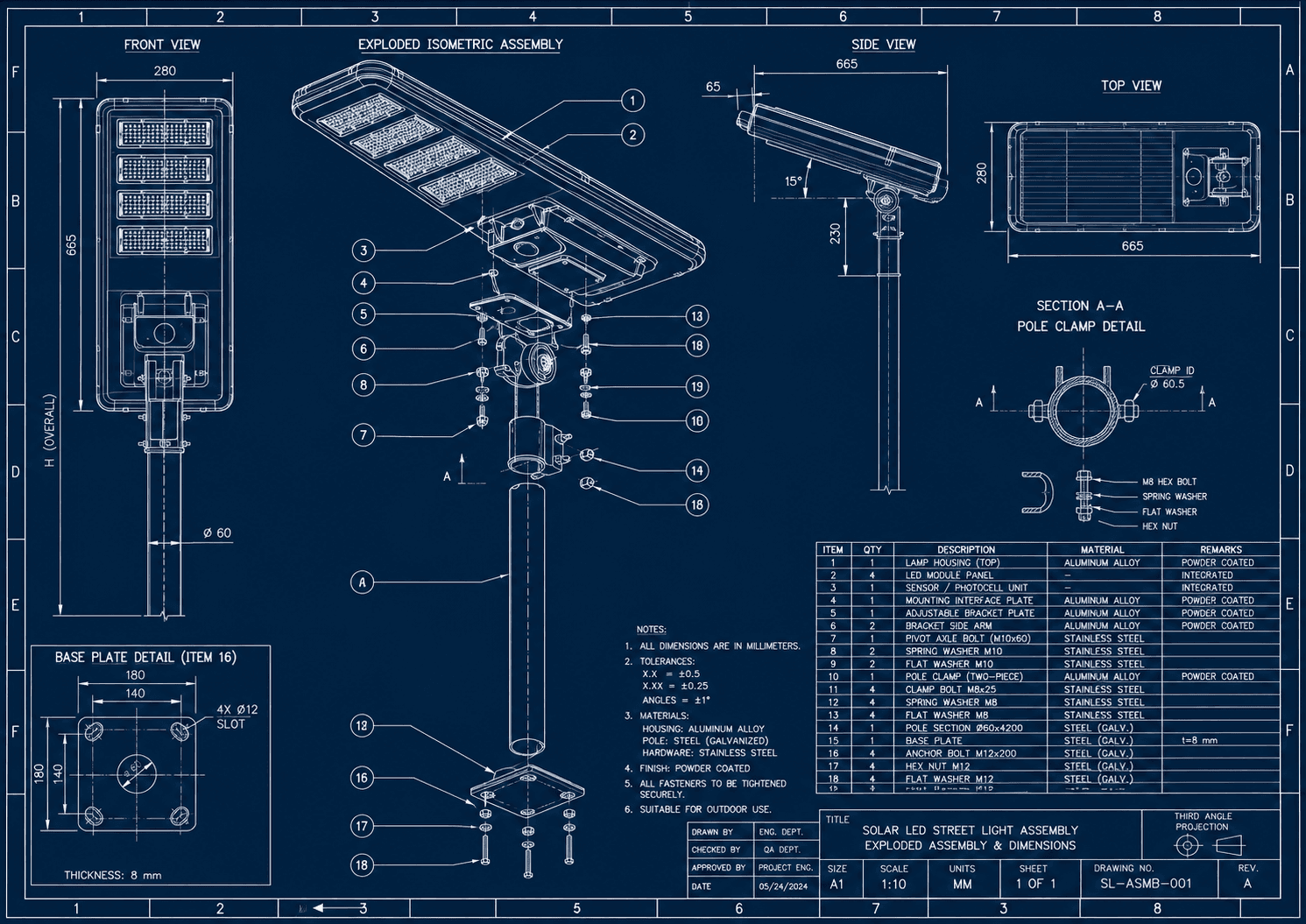
Where the requirement genuinely does not fit an existing platform we design and tool a new housing: design review, prototype, sample approval, then production. This is the longest and most expensive path, and it is how several of our current series began. We will tell you plainly when a variant of something existing would serve you better.
How a custom order runs
- 01
Specification review
Send a specification, a tender clause, a competitor datasheet, or a drawing. We mark up what an existing series already meets, what is a production change, and what needs tooling — with an honest note on anything we think is a bad idea.
- 02
Quotation and lead time
A quote against a defined specification, with the MOQ stated rather than implied, tooling cost separated from unit cost, and a lead time that accounts for certification if new testing is involved.
- 03
Sample and approval
A production-intent sample for your approval. For solar we run an autonomy check rather than only a visual inspection, because the failure mode you care about does not show up on a bench in daylight.
- 04
Production and QA
Batch production with in-line testing: ageing, voltage range, surge, ingress, and photometric verification against the approved sample. Third-party inspection is welcome and we will book access.
- 05
Packing and shipment
Export packing as standard — individual cartons in master cartons, palletised for container loading. We are close to Shenzhen and Guangzhou ports and quote FOB or CIF as you prefer.
Where the limits are
New tooling is a real cost and a real timeline, and it only pays back over volume. If your quantity does not justify it we will say so and propose the closest existing platform instead of taking the tooling order.
We will also tell you when a specification is internally inconsistent — an autonomy figure a given panel and battery cannot deliver, or a lux target that mounting height makes unreachable. Discovering that after production is considerably more expensive than hearing it during specification review.
OEM and ODM questions
What is the difference between OEM and ODM here?
OEM means we manufacture an existing design carrying your brand — your logo, carton, and manual on a series already in production, optionally with specification changes such as colour temperature or driver brand. ODM means we design and tool something new to your requirement, which involves design review, prototyping, and sample approval before production. OEM is faster and cheaper; ODM gives you a product nobody else sells.
What is the minimum order quantity for custom lighting?
It depends entirely on how deep the change goes. Private-label branding on an existing series carries the lowest MOQ because the product is already in production. A specification change is higher, and new housing tooling higher again because the tooling cost has to amortise. We state the MOQ in the quotation against your defined specification rather than publishing a single number that would be wrong for most enquiries.
How long does a custom lighting order take?
Private-label production on an existing series runs close to standard lead time. Specification changes add modestly. New tooling is the long path — design review, prototype, sample approval, then production — and if the destination market needs national certification testing, that timeline usually dominates everything else. We give you a lead time broken down by stage in the quotation so you can see what is driving it.
Can you match or improve on a competitor product?
Usually, and the useful first step is to send the datasheet. We will tell you which of our existing platforms is closest, where we are genuinely better, and where we are not — including cases where the honest answer is that the competitor product is well matched to your requirement and a custom build would not improve it.
Do you provide photometric files and lighting calculations?
Yes. We supply IES and LDT files for your designer, and we will run the calculation ourselves in Dialux or Relux if you prefer. For road projects that means a layout demonstrating the target lighting class for your specific road width, pole height, and spacing — which is what a tender asks for, since EN 13201 is a performance standard for the lit road rather than a certification a luminaire carries alone.
Are you a factory or a trading company?
A factory. We manufacture in Guzhen, Zhongshan — 4F, Building 2, Fulín Smart Lighting Manufacturing Industrial Park — which is why driver, LED, optic, housing, battery, and firmware are all things we can change rather than pass along. Factory visits and third-party inspection are welcome.
Browse the standard range
Send us a specification
A tender clause, a competitor datasheet, a drawing, or just the application and quantity. We will tell you what it maps to and what it costs. English, French, and Arabic.