Outdoor lighting — street
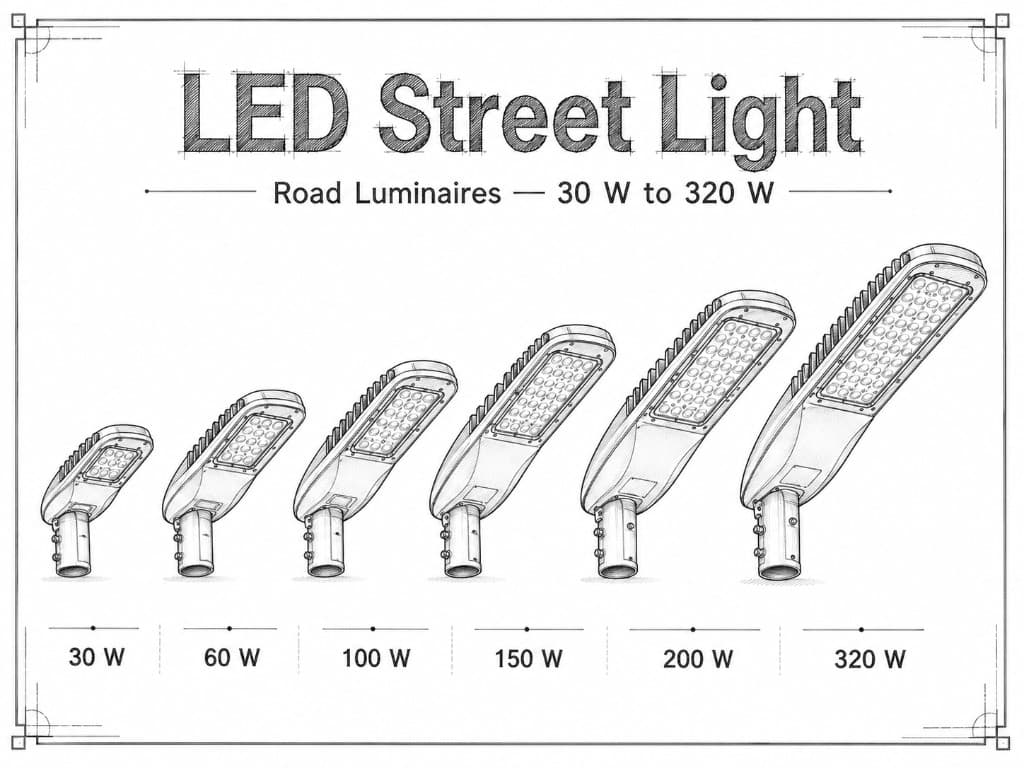
LED street light manufacturer — road luminaires from 30 W to 320 W
Six street lighting series for highways, urban arterials, residential streets, and boulevards — including a LoRaWAN smart series at over 175 lm/W. Manufactured in Guzhen and available for OEM and ODM.
Outdoor lighting — street
Street lighting is judged on uniformity and glare control, not on brightness. A road lit to the correct average lux with poor uniformity is more dangerous than one lit to a lower level evenly, because the dark patches between poles are where drivers stop seeing pedestrians. Every series in this range is designed around beam distribution first.
The six series differ mainly in optical distribution, efficacy, and control capability. A residential street, a dual carriageway, and a motorway are three different optical problems, and using one luminaire for all three means over-lighting some roads and under-lighting others. Below is what each series is for.
The street light range
Six series covering residential streets through motorways and IoT-managed networks. Full specifications and wattage variants on each product page.
STW01 DOB Street Light
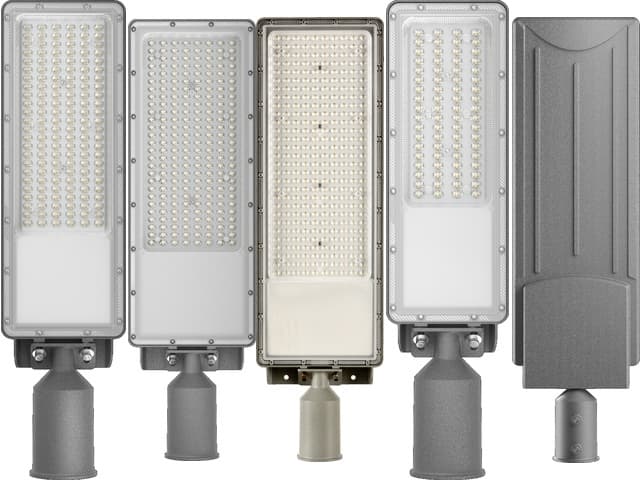
The STW01 DOB street light is engineered for roads, highways and urban arterials. Its aerodynamic aluminium housing operates at −40 °C and achieves IP65 protection, while a 75°/140° asymmetric beam pattern maximises road surface uniformity. Four power options (50–200 W) deliver 6,000–22,000 lm. AC 100–277 V input and 4 KV surge protection ensure global compatibility. CE, RoHS and CCC certified.
View specifications →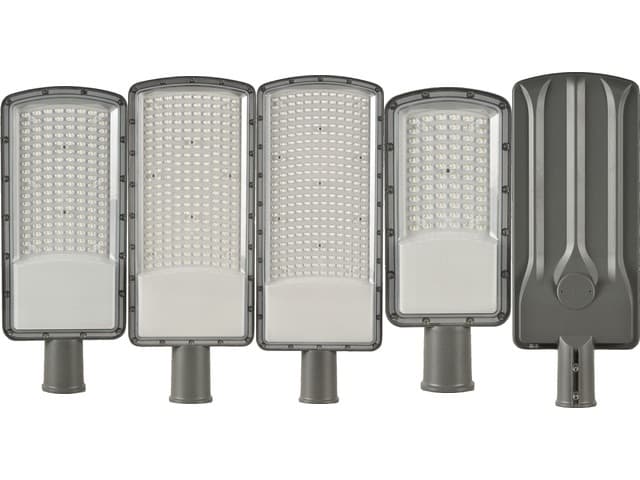
STW02 DOB Street Light
The STW02 features a slimmer die-cast housing than the STW01, making it ideal for residential streets and secondary roads where a lower visual impact is preferred. It delivers 6,000–22,000 lm across 50–200 W at a 75°/140° asymmetric distribution. IP65 protection, −40 °C cold-start capability and 4 KV surge shielding are standard. AC 100–277 V wide input ensures it can be deployed globally. CE, RoHS and CCC certified.
View specifications →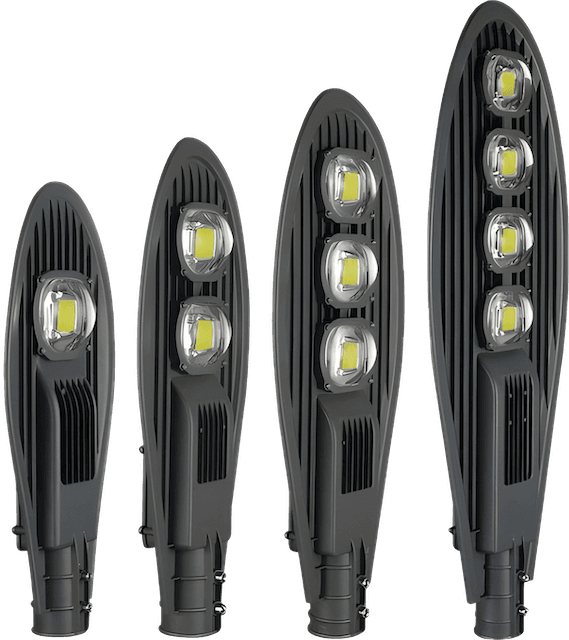
COB Street Light
The COB Street Light uses Birdgelux COB LED modules to deliver uniform, high-intensity illumination from 5,000 to 30,000 lm across 50–300 W. Its robust 90°/140° dual-beam option and multi-level surge protection (4–20 KV) make it the premium choice for main arterials and interchange junctions. IP65 certified and rated to −40 °C. AC 100–277 V. CE, RoHS certified.
View specifications →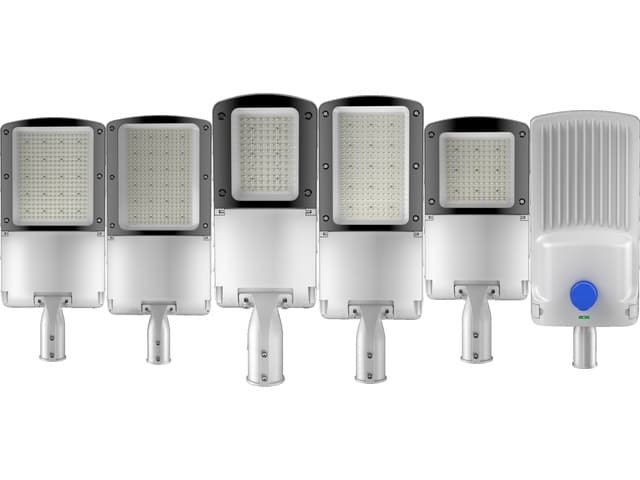
RST13 LED Street Light
The RST13 achieves 120 lm/W luminous efficiency across a wide power range of 30–320 W, making it one of the most economical street-lighting choices in the Jupiter Made-Well range. IP65, IP67 optional, and a −40 °C operational rating suit it for harsh climates. Multi-level surge protection (up to 20 KV) and a 75°/160° wide-throw beam ensure both resilience and road uniformity. AC 100–277 V. CE, RoHS certified.
View specifications →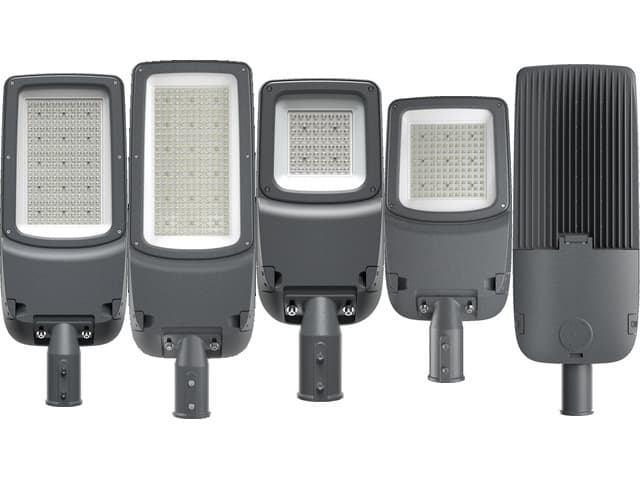
RSN12 LED Street Light
The RSN12 features a 90°/180° wide-throw beam designed to illuminate broad boulevards and dual-carriageways without extra fixtures. At 120 lm/W efficiency over 40–240 W, it cuts operating costs while maintaining excellent road uniformity. IP65, −40 °C cold-start and multi-level surge protection (up to 20 KV) ensure all-climate durability. AC 100–277 V. CE, RoHS certified.
View specifications →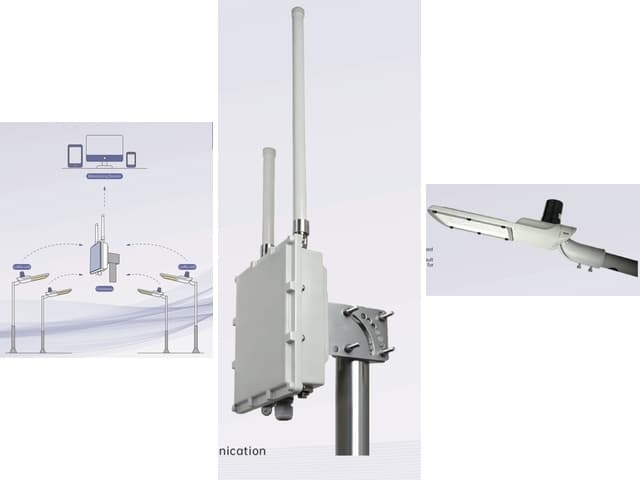
Smart Series Street Light
The Smart Series is Jupiter Made-Well's IoT-enabled street light, combining >175 lm/W Gree/Lumileds/OSRAM LEDs with a LoRaWAN and 2.4G MESH dual-mode wireless controller. Remote dimming, fault reporting, and scheduled on/off programmes are managed from a cloud dashboard. The MEAN WELL XLG IP67 isolated driver carries a 5-year warranty and supports 0–10 V dimming. Power range 100–240 W, 20 KV surge protection, IP65, system lifespan >10 years.
View specifications →Street light specification comparison
Side-by-side specifications for every street lighting series we manufacture, including efficacy and surge rating.
| Specification | STW01STW01 DOB Street Light | STW02STW02 DOB Street Light | COB-SLCOB Street Light | RST13RST13 LED Street Light | RSN12RSN12 LED Street Light | SMART-SLSmart Series Street Light |
|---|---|---|---|---|---|---|
| Series | STW01 DOB Street Light | STW02 DOB Street Light | COB Street Light | RST13 | RSN12 | Smart Series |
| Power Range | 50–200 W | 50–200 W | 50–300 W | 30–320 W | 40–240 W | 100–240 W |
| Total Lumen | 6,000–22,000 lm | 6,000–22,000 lm | 5,000–30,000 lm | — | — | — |
| Luminous Efficacy | — | — | — | 120 lm/W | 120 lm/W | >175 lm/W |
| Beam Angle | 75°/140° | 75°/140° | 90°/140° | 75°/160° | 90°/180° | — |
| Input Voltage | AC 100–277 V | AC 100–277 V | AC 100–277 V | AC 100–277 V | AC 100–277 V | — |
| Power Factor | 0.6/0.9 | 0.6/0.9 | 0.9 | 0.9 | 0.9 | — |
| Surge Protection | 4 KV | 4 KV | 4–20 KV Multi-Level | 4–20 KV Multi-Level | 4–20 KV Multi-Level | 20 KV |
| IP Rating | IP65 | IP65 | IP65 | IP65 (IP67 optional) | IP65 | IP65 |
| Operating Temp. | −40 °C to +50 °C | −40 °C to +50 °C | −40 °C to +50 °C | −40 °C to +50 °C | −40 °C to +50 °C | — |
| Certifications | CE, RoHS, CCC | CE, RoHS, CCC | CE, RoHS | CE, RoHS | CE, RoHS | CE, RoHS |
A dash means the specification is not published for that series. Test reports are available on request for tender submissions.
Which street light for which road
Based on the road classes we quote most often. Road width, pole height, and spacing determine the answer more than wattage does.
| Road class or application | Recommended series |
|---|---|
| Highway, motorway, or urban arterial | STW01 DOB street light, rated to −40 °C |
| Residential and secondary roads, lower visual bulk | STW02 DOB, slim die-cast housing |
| Wide boulevard or dual carriageway lit from one side | RSN12, 90°/180° wide-throw at 120 lm/W |
| Large municipal retrofit on a fixed budget per pole | RST13, 30–320 W at 120 lm/W |
| High-intensity uniform output, storm-prone or overhead-fed network | COB street light, 50–300 W, up to 20 KV surge |
| Smart city, remote dimming, fault reporting, energy metering | Smart series, >175 lm/W, LoRaWAN and 2.4 G MESH |
LED street lights
Matching optical distribution to the road
Beam distribution decides pole spacing, and pole spacing decides project cost far more than the price of the luminaire. The RSN12 uses a 90 degree and 180 degree wide-throw distribution specifically so that broad boulevards and dual carriageways can be lit from one side without a second row of poles — on a wide road that can remove a third of the civil works.
For narrower roads a wide-throw beam is wasted light and a glare problem. The STW02 uses a tighter distribution in a slimmer housing for residential and secondary roads, and the STW01 sits between the two for arterials and highways. Send the road width, pole height, and spacing and we will tell you which distribution closes the uniformity requirement.
Efficacy, and what it is worth over ten years
The RST13 delivers 120 lm/W across a 30–320 W range, which makes it the economical choice for large municipal replacement programmes where the budget is fixed per pole. The Smart series exceeds 175 lm/W using Cree, Lumileds, or OSRAM packages.
That gap is worth quantifying rather than assuming. On a thousand-pole installation running four thousand hours a year, moving from 120 to 175 lm/W at equal light output cuts connected load by roughly a third — which either shows up as energy saving or lets you use a smaller supply and thinner cable. On a small private road the difference will never repay the premium. Ask us to run the comparison on your actual pole count.
Smart street lighting and LoRaWAN control
The Smart series carries LoRaWAN and 2.4 GHz MESH radio, which allows dimming schedules, fault reporting, and per-pole energy metering without running control cable. For a municipality the useful part is usually not the dimming but the fault reporting: knowing which pole has failed, rather than waiting for a resident to call it in.
LoRaWAN suits long, thin topologies like roads because of its range; MESH suits dense grids like car parks and campuses. Both are supported. If you already run a central management system, tell us which one and we will confirm the integration path before you order rather than after.
Surge protection, cold starts, and housing
Pole-top luminaires take the worst of the electrical environment, which is why the COB series carries surge protection up to 20 KV. On overhead-fed rural networks and in regions with frequent storms that rating is the difference between a maintenance contract and a warranty claim.
The STW01 housing is rated to start and run at −40 °C, so it is specified for high-altitude and continental-winter installations where a standard driver simply will not ignite. Housings across the range are die-cast aluminium with an aerodynamic profile — wind loading on a pole is a structural calculation, and a flat slab luminaire at 12 m changes the pole specification.
Custom street light production — OEM and ODM
Municipal tenders frequently specify things no catalogue luminaire offers: a particular arm fitting, a mandated CCT, a national certification mark, or a housing that matches street furniture already installed. As the manufacturer we can change those at source instead of telling you the catalogue does not go there.
Common custom work on this range is private-label branding, a specified LED or driver brand named in the tender, bespoke optical distribution for an unusual road geometry, and pole-adapter tooling. Send the tender specification and we will mark up which clauses an existing series already meets and which need a custom build.
LED street light questions buyers ask
Do your street lights meet EN 13201 road lighting classes?
EN 13201 is a performance standard for the lit road, not a certification a luminaire carries on its own — compliance is demonstrated by the photometric design for your specific geometry. Send road width, pole height, spacing, and the target class and we will produce the Dialux calculation showing whether the design meets it, with the luminaire and wattage that gets you there.
What surge protection do your street lights have?
It varies by series. The COB street light carries protection up to 20 KV, which we recommend for overhead-fed and storm-prone networks. Other series carry lower ratings that are appropriate for underground-fed urban installations. External SPD modules can be fitted as a custom build where local code requires a specific rating.
Can street lights be dimmed or controlled remotely?
The Smart series supports remote dimming schedules, fault reporting, and per-pole energy metering over LoRaWAN or 2.4 GHz MESH, with no control cable required. Other series can be supplied with dimmable drivers where the specification calls for it. If you already operate a central management system, tell us which and we will confirm the integration path before you order.
How many street lights do I need, and at what spacing?
That comes out of the photometric calculation, not a rule of thumb — it depends on road width, pole height, mounting arm, the target lighting class, and the luminaire distribution. Send those inputs and we will return a layout showing pole positions, spacing, average lux, and uniformity ratio. Getting this right usually saves more than negotiating the unit price.
What is the efficacy of your LED street lights?
The RST13 runs at 120 lm/W across 30–320 W, and the Smart series exceeds 175 lm/W using Cree, Lumileds, or OSRAM packages. Higher efficacy reduces connected load for the same light on the road, which on a large installation can also let you reduce supply and cable sizing. On small projects the premium rarely repays itself — ask us to run the numbers on your pole count.
Can you supply street lights with our own brand?
Yes. Private-label branding on the housing, carton, and manual is routine, as are a specified LED or driver brand, a mandated colour temperature, and pole-adapter tooling for existing brackets. We manufacture in Guzhen, so these are changes to a production run rather than a request passed to a third party.
Other product families
Request a street light quote
Send road class, pole height, spacing, and quantity — or ask us for the photometric design first. Quotes in English, French, and Arabic.